ERP for trading businesses
In trading, your margin depends on small things like the landed cost of a container, the rate you quoted a customer and whether your supplier filed their GST return. ERPNext keeps all of it in one set of books, so you can see the margin on each sale.


Problem and fix
What usually goes wrong, and what fixes it.
01
You only see your margin at year end
Freight, duty and clearing get booked as expenses, so you can't see the margin on any one item or invoice until the accountant closes the books.

Landed cost voucher
ERPNext buying
02
Prices live in salespeople's phones
Every customer has their own rate, quantity slab and informal discount, and nobody can say for sure which price is current.
Pricing rules
ERPNext selling
03
The same stock gets sold twice
Two salespeople promise the same lot to different customers, because the stock isn't reserved against an order.
Stock reservation
ERPNext selling
04
Input tax credit slips away
Suppliers file late or get it wrong, and the credit in your books doesn't match GSTR-2B.
GSTR-2B reconciliation
India Compliance app
The modules
The Frappe apps and modules we use.
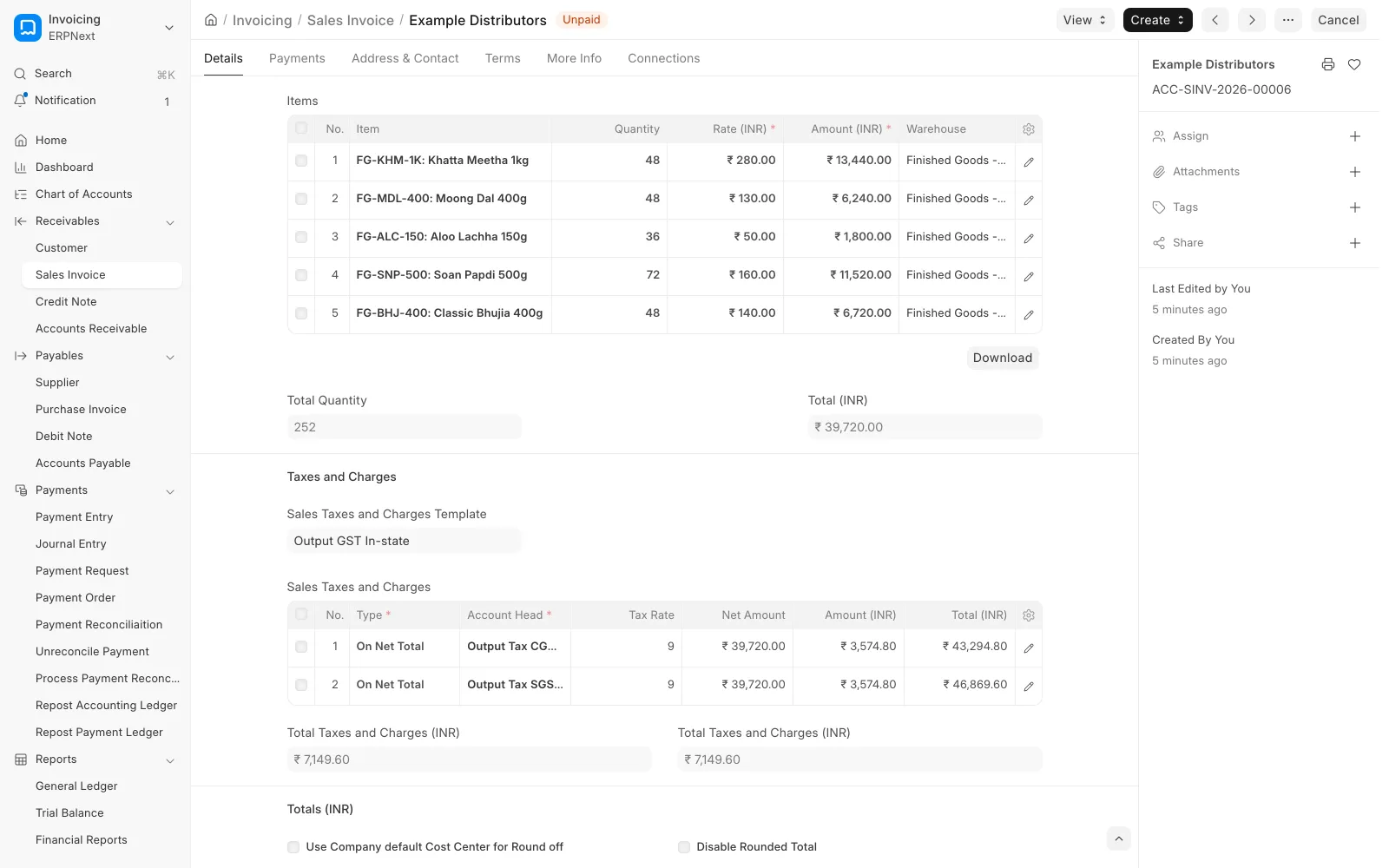
ERPNext selling and pricingPrice lists and item prices, Pricing rules, Credit limits, Stock reservation
- Price lists and item prices
- Separate buying and selling price lists, in more than one currency if needed.
- Pricing rules
- Discounts or fixed rates by customer, customer group, territory or minimum quantity, applied to the order for you so nobody has to retype them.
- Credit limits
- Set per customer and company. An order that goes over the limit waits for someone to approve it.
- Stock reservation
- You can reserve stock against a sales order, so it isn't promised to two customers.
ERPNext buying and accountsLanded cost voucher, Blanket orders, Tax withholding, Multi-currency
- Landed cost voucher
- Freight, duty and clearing charges go into the item's valuation, so the margin you see on each invoice is the real one.
- Blanket orders
- You agree a rate with a supplier or customer for a period, then draw against it with individual orders.
- Tax withholding
- TDS categories with their thresholds and rates, applied on purchase invoices.
- Multi-currency
- Book import purchases in foreign currency, and the exchange gain or loss is posted when you pay.
Compliance
India compliance notes.
- GSTR-2B matching and GSTR-1
- E-invoicing with IRN and QR code
- E-way bills from the invoice or delivery note
- TDS on purchase of goods
The detail on eachThresholds, returns and how we set each one up.
- GSTR-2B matching and GSTR-1
- The input tax credit you can claim depends on what your suppliers file. India Compliance matches your purchase invoices against GSTR-2B and GSTR-2A, and it prepares your GSTR-1.
- E-invoicing with IRN and QR code
- If your turnover is above the notified threshold, you need to issue e-invoices. The India Compliance app generates the IRN and signed QR code from the sales invoice through the NIC portal.
- E-way bills from the invoice or delivery note
- Most goods movements above Rs 50,000 in consignment value need an e-way bill. India Compliance generates it from the sales invoice or delivery note, with the transporter and vehicle details filled in.
- TDS on purchase of goods
- If you're a larger buyer, TDS on purchase of goods applies once your purchases from a supplier cross a threshold. We set it up as a tax withholding category and check it with your auditor before go-live.
Engagement
How a project with us runs.
01
A call
30 minutes, no charge
02
Discovery
1 to 2 weeks, paid
03
Blueprint
Included in discovery
04
Build
3 to 8 weeks
05
Acceptance
1 to 2 weeks
06
Go-live and run
Ongoing
We explain the full method, and why we charge for discovery, on the services page.
Evidence
Our work in this sector.
No case study yet
We haven't published a trading case study yet, so the problems and features above come from how we scope a trading business and what ERPNext does, rather than from a past client.
So far we've published case studies in Education and IT services. You can read all of them on the work page.
Questions buyers actually ask.
For buying, stocking and selling under GST, yes. Pricing rules, landed cost, stock reservation and GST reconciliation all come standard. The things we'd check are your transaction volume and any marketplace integrations you need.
Yes. Pricing rules apply a rate or discount by customer, group, territory or quantity, and each order shows which rule set its rate.
The landed cost voucher spreads freight, duty and clearing charges onto the items received, by quantity or by value.
We move masters, opening balances, open receivables and payables, and open orders. Closed history usually stays in Tally for reference, and we reconcile the migration ledger by ledger.
Services for this sector.
- ERPNext implementationAccounts, stock, buying, selling and manufacturing, with your setup kept in code.
- Tally to ERPNext migrationWe move your masters, opening balances and open documents across, then reconcile them.
- ERP discovery and blueprintA paid, signed requirements document you can take to any implementer.
- Frappe CRM implementationPipelines that match how your team actually sells or admits.
Let's start with a call.
Thirty minutes, free of charge, and you won't sit through a sales deck.